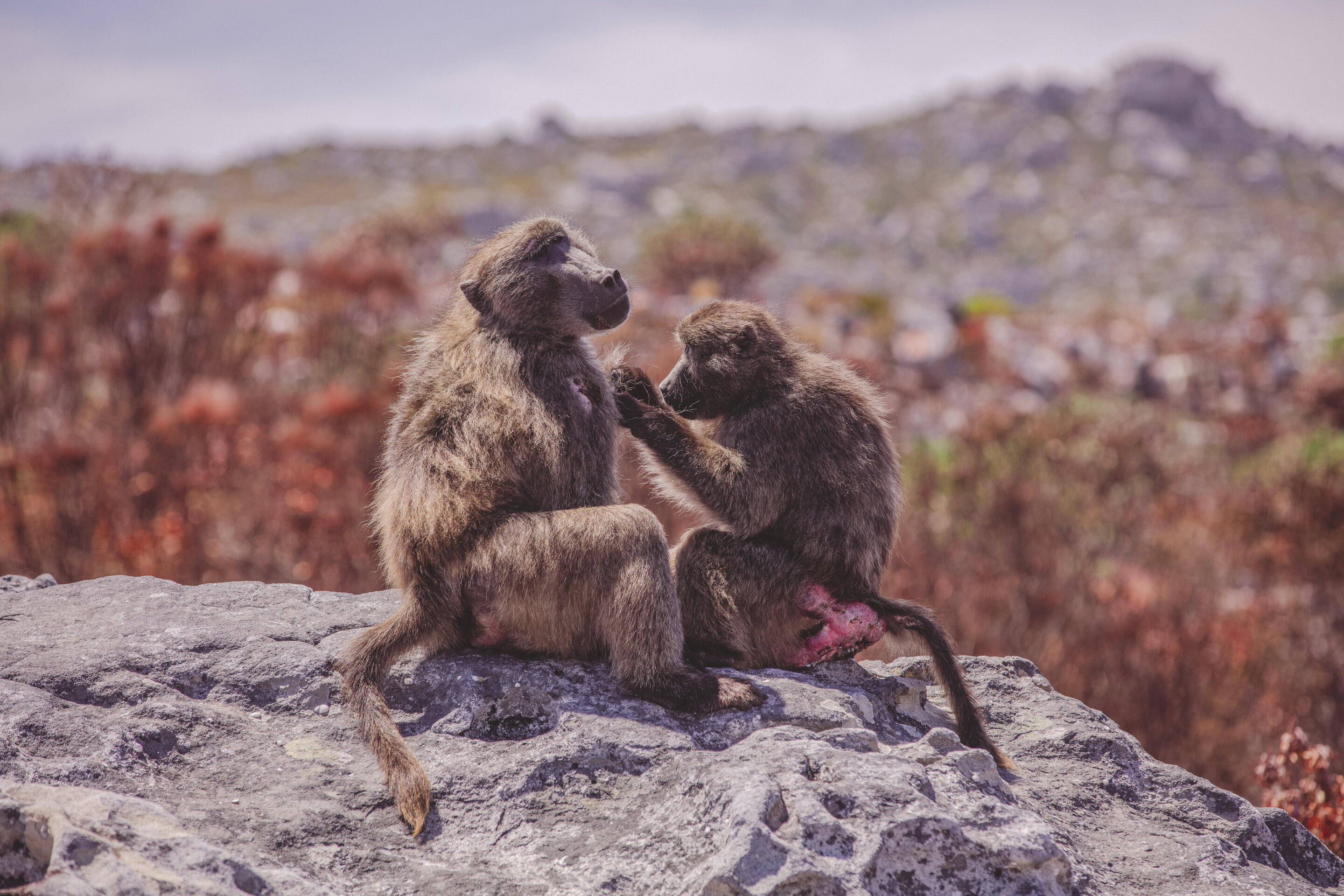
Animal Behaviors Project · 2026

Baboons:
Zoo Life vs. Life in the Wild

By Stella Devine  ·  Class 606
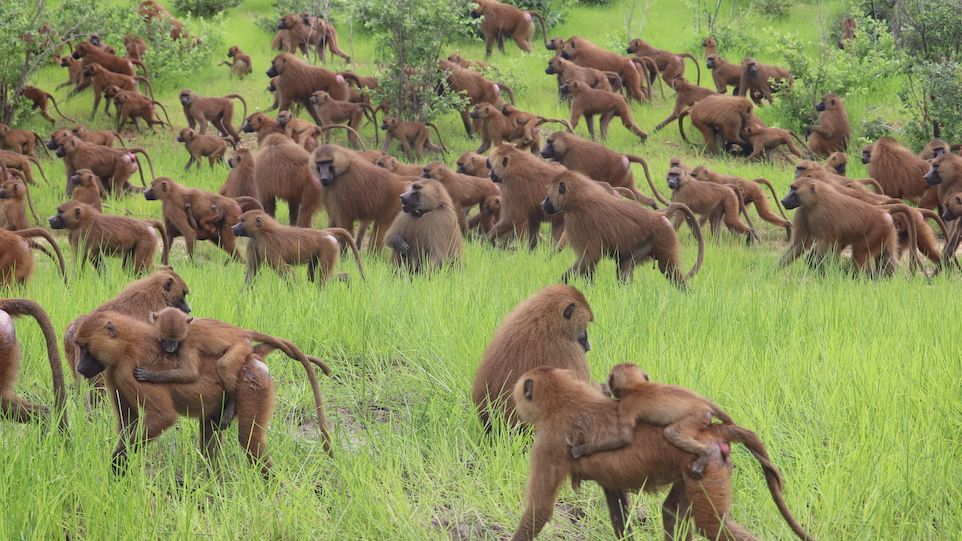
A large group of baboons moving through grassy savanna
Source: Leibniz Association

Research Question

"How does life in the San Diego Zoo affect the mental and physical health of baboons compared to their natural life in the African savanna?"

For this project, I researched baboon behavior, their natural habitat, and what life is like for baboons at the San Diego Zoo. I also watched baboons at the zoo and recorded what they were doing every minute. By the end, I came up with three ideas for how the zoo could better meet the baboons' needs.
Section 1

Classification & Anatomy

Connection to Our Research Question: Understanding what baboons look like and how they are built helps us figure out what their bodies are made for, and whether zoo life is letting them use those bodies the way nature intended.

Scientific Name

The scientific name for all baboons is Papio . This is the genus name, which covers all five species of baboon.

Baboons belong to the family Cercopithecidae and the tribe Papionini. These are groups of Old World monkeys, monkeys that live in Africa and Asia.

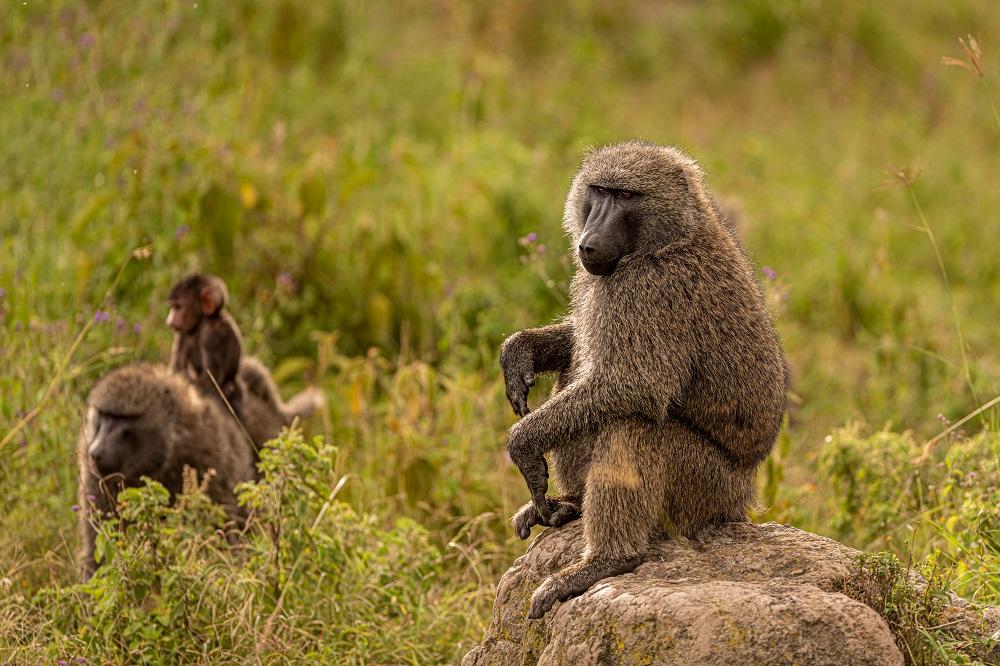
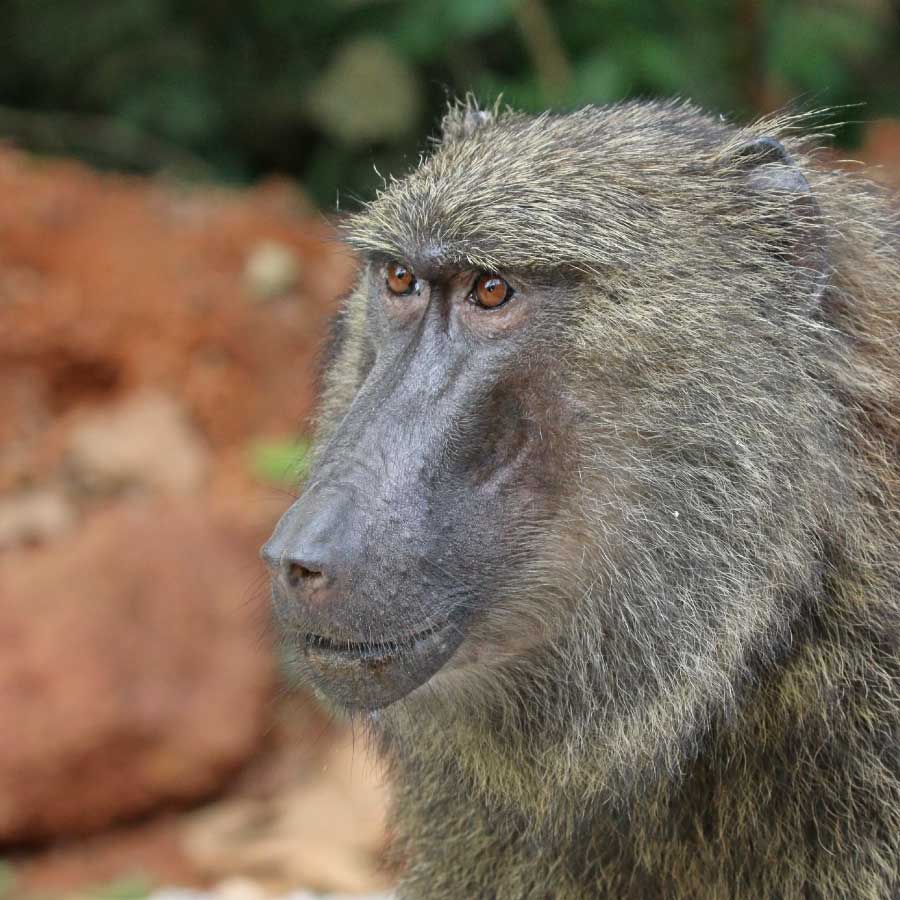
Close-up of an olive baboon showing its long muzzle and dark face
Source: Active Wild

Related Species

Baboons are most closely related to geladas, macaques, mandrills, and drills. All of these animals are part of the same tribe, Papionini , within the family Cercopithecidae.

A lot of people think baboons are related to apes like chimpanzees or gorillas, but they are actually not. Baboons and apes split apart from each other about 25 to 30 million years ago. Apes belong to a group called Hominoidea, which are primates without tails. Baboons belong to Cercopithecoidea, which are primates that do have tails.

Even though baboons aren't apes, they do share about 94% of their DNA with humans , which shows how closely related all primates are.

The Five Baboon Species

Olive Baboon

Olive baboons have a greenish-gray coat, a long muzzle, a dark face with deep eyes, and large canine teeth, while males have a prominent mane and being larger than females, plus a "broken looking" tail that rises and then angles sharply downward. Their "olive" coat is actually a mix of yellow-brown and black-ringed hairs. Infants are born with black fur and pink skin. Males are nearly double the size of females, weighing up to 110 lbs and standing 28 inches tall at the shoulder. While females can weigh an average of 32 lbs, and are shorter than males at 22 inches.

Yellow Baboon

Yellow baboons are characterized by their slim, dog-like muzzle, yellow-brown fur, and long arms and legs adapted for a land-based and physical life. They are highly sexually dimorphic, with males weighing up to 25.8kg and females about 11kg, featuring black hairless faces, white "sideburns," and curved tails. Infants are born with black fur, which gradually turns into the characteristic light yellow-brown as they age.

Chacma Baboon

Chacma baboons are in fact one of the world's largest species of monkeys, and the biggest baboon. These baboons have rough dark brown to grey fur and a naked muzzle. They have small beady eyes close together, Males are twice as long and three times as heavy as females. Males have long sharp canine teeth which can be up to 4 cm.

Guinea Baboon

Guinea baboons are small, reddish-brown monkeys found in West African woodlands and savannas. Diurnal and highly terrestrial, they are known for their "dog-like" black faces, arched tails. They are the smallest baboon species, weighing 13–26 kg, 28.6 lbs to 57 lbs . Body length ranges from 45 to 83 cm, with males being larger and developing a protective mane of hair around the neck and shoulders. Guinea baboon babies are born with black skin and fine hair, typically weighing about 2 lbs.

Hamadryas Baboon

have bare red skin on their faces and behinds, and cheek pouches for storing food. Males are almost twice the size of females and develop a silvery, mane-like cape around their shoulders and head at maturity. The biggest difference between the genders' physical description is the fact females are smaller, brown, and lack the mane, possessing short, plain olive-brown fur. As noted on San Diego Zoo Animals and plants site and on Animal Diversity Web, these physical differences, or sexual dimorphism, are closely tied to the social structure of the species. Male hamadryas baboons maintain harems, necessitating their larger size for protection whereas females are largely focused on maintaining strong bonds with their Hamadryas Baboon.

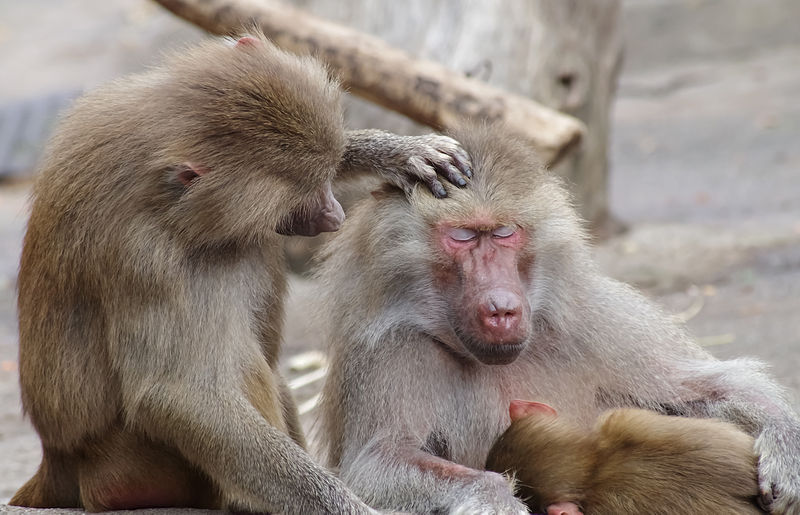
Hamadryas baboons together, showing differences between individuals
Source: The Ethogram

Section 2

Natural Habitat & Ecology

Connection to Our Research Question: Knowing where baboons naturally live and what they do there helps us see what might be missing from their life at the San Diego Zoo.

Baboon in an African savanna landscape with grassland and scattered trees
Source: New England Primate Conservancy

Where Baboons Live

Baboons mostly live in savannas, woodlands, and rocky areas. They are mainly terrestrial, which means they spend most of their time on the ground. Depending on the species, baboons can also live in dry deserts, tropical forests, and mountainous regions. They rely on having a water source nearby and usually look for cliff sides to sleep on at night for protection.

Their Role in the Ecosystem

Baboons are called "ecological engineers." This means they help take care of their environment in important ways:

  • They are a food source for big predators like lions, leopards, and eagles.
  • They help spread seeds by eating fruits and moving around.
  • When they dig up roots, tubers, and corn to eat, they aerate the soil and create small habitats where new plants can grow.
  • They eat insects, scorpions, and small rodents, which acts as a kind of natural pest control.
  • Chacma baboons are known to turn over rocks while looking for food, which also affects the environment around them.

"We need to consider that baboons are highly resilient adaptable animals, so if we begin to detect a decline in their population, we must consider that the less resilient animals are potentially already in a worse condition."

— The Conversation

Conservation Status

Baboons are not endangered.

Section 3

Key Adaptations

Connection to Our Research Question: These are the things baboons are built to do in the wild. When we compare this to what I observed at the San Diego Zoo, we can start to see what the zoo might not be giving them.

🦶

They Travel a Lot Every Day

Baboons are extremely active and physical animals. In the wild, they walk about 3 to 8 miles (5–13 km) every single day. Chacma baboons can walk up to 12–15 km per day when food is hard to find.

Baboons spend about 75% of their day "making a living," which means they are walking around and searching for food most of the time. This shows that movement is not just something they enjoy, it is a key part of how they survive.

⛰️

High Ground

Baboons need access to high ground to explore. Being higher up allows the troop to spot potential threats or food sources from a distance. Being on high ground allows a measure of safety and survival.

🤲

Foraging Technique

Another key adaptation for baboons is an important benefit for how baboons forage and climb. Both hands and feet have opposable thumbs on both feet and hands which supports a large amount of foraging for natural resources.

🤝

Grooming Behavior

Grooming is a huge part of baboon life. It is an important factor in keeping a positive social structure within a troop. Grooming helps baboons stay social with each other and helps maintain the social hierarchy inside the group. Baboons can spend up to 50% of their day engaged in this activity.

🗣️

Vocalization

Baboons also have a way of talking, though it may not sound like your average day to day talking, they vocalize to help themselves and troops know when a threat is in the area, coordinating group movement and social bonding. Baboons also utilize sounds, lip smacking, yawning and facial expressions to have a conversation with each other.

They also use lip smacking, yawning, and facial expressions to "have a conversation" with each other.

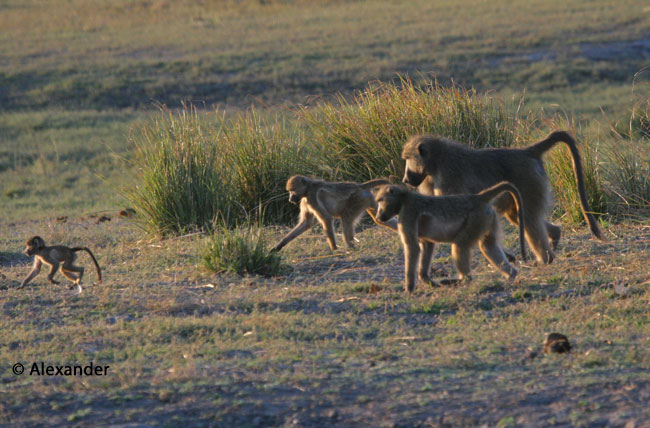
Baboons walking across open savanna ground
Source: Jet Eliot

Section 4

Life Cycle

Connection to Our Research Question: Understanding how baboons grow up in the wild helps us think about whether the zoo environment supports those natural stages of development.

Potential lifespan

30–45 Years

Average wild lifespan

~11.5 Years

Female menopause

~Age 26

1

Infancy

0–1 year

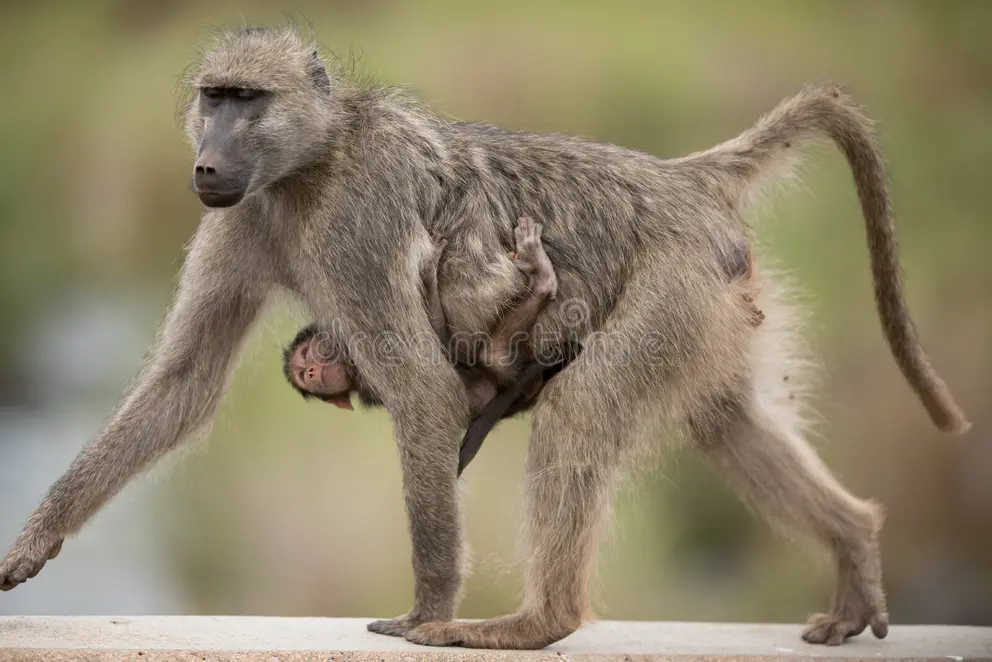
Baboons can have total dependence on the mother for the first few months, followed by rapid development, weaning, and increased social interaction. Most baboons weigh about 2 pounds, about 7% of its mothers size. Although the baboon infant is not able to run about on its own, it is born with a very strong gripping ability. This strong grip allows the infant to help its mother carry it all day; the infant clings to the fur on its mothers belly. Infant baboons are extremely dependent on their mothers for 2 years of their lives.

Baby baboon clinging to its mother's belly
Source: Dreamstime
2

Juvenile

1–4 years

The juvenile period for baboons, mostly lasting from approximately age two until sexual maturity (around 4–6 years for females, 6–8 years for males), is a phase of increasing independence from the mother, increasing social learning, and fast development of foraging skills. During this stage, juvenile baboons go from being constantly carried to becoming active members of the troop who frequently forage on their own. It usually has a younger sibling and is pretty much on its own most of the time. Juvenile baboons spend most of their time feeding, exploring, and doing lots of playing with other juveniles in their tribe.

3

Adolescence

4–8 years

In the period of adolescence, Baboons reach development in their physical, sexual and social development, it can be portrayed as puberty for baboons. Female baboons start the menstruation process, and begin to become highly interested in adult males, engaging in social grooming and presenting behaviors to males. Soon, females engage in their first sexual interaction with a male baboon around 4.5 years old, females then have their first offspring at 6 years old. While females mature sexually, males mature in a way of growing. Males have a rapid growth spurt , and reproductive parts start to enlarge. Male baboons in the adolescent period, begin to leave their native tribe to avoid inbreeding. Both genders develop independence, and start to learn their rank in their tribe, males are more frequently challenged by adult males as they grow.

4

Adulthood

~6–8 years onward

Baboon’s adult hood which is basically the last period before death for baboons. In this stage most baboons have left their tribe to prevent inbreeding, and for both genders most social skills, physical and mental development has been completed. Female adulthood for the most part is keeping stability in the native troop and forming more social bonds while raising an offspring, their rank is inherited by their mother. Male baboons in adulthood are more competitive. Males leave their native tribe and decide to fight for a higher rank in their new tribe to gain new and better mating opportunities, male hierarchies start to become unstable compared to females.

Section 5

Ethogram & Analysis

I watched baboons at the San Diego Zoo four different times, for 10 minutes each time. Every minute, I recorded what behaviors I could see the baboons doing. The number in each cell is how many baboons I saw doing that behavior during that minute.

Connection to Our Research Question: This is the most direct part of the project where I can compare baboon behavior in the zoo to what baboons do in the wild. The data shows where the zoo is falling short.

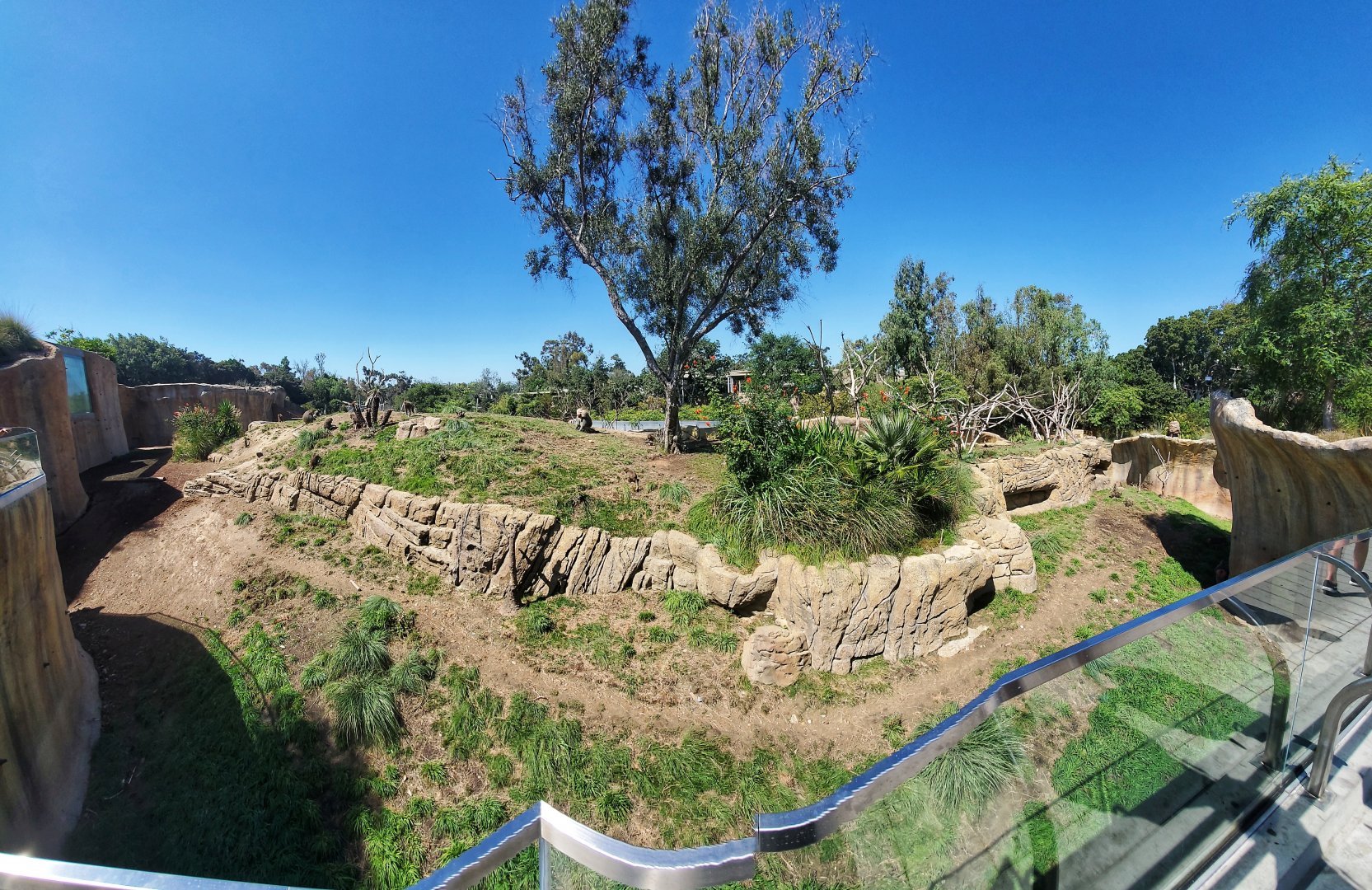
Baboon enclosure at the San Diego Zoo

Source: ZooChat

Two baboons grooming each other

Source: Phys.org

Behavior Totals — All Sessions Combined

Grooming was the most common behavior in almost every session. Active behaviors like playing and eating were very low.

Session 1

Grooming and moving were most common. By minute 10, several baboons were asleep.

Session 2

Grooming was dominant. No eating was observed. Picking at grass spiked at minute 4.

Session 3

The most active session. Grooming, grass-picking, and moving were all high. Still no eating.

Session 4

Very little activity for most of the session. A big burst of movement at minute 7 (9 baboons moving at once).

Raw Observation Data

Session 1

Min Sleep Eat Play Groom Move Grass

Session 2

Min Sleep Eat Play Groom Move Grass

Session 3

Min Sleep Eat Play Groom Move Grass

Session 4

Min Sleep Eat Play Groom Move Grass

What the Data Tells Us: Zoo vs. Wild

View My I2 Protocol

A summary of every behavior observed across all four sessions, side-by-side with what stood out and why it matters.

Share of Total Behaviors Observed

What I Observed

  • The baboons spent about 41% of their time grooming each other. This is a really important behavior because grooming helps baboons bond and is also important for their survival.
  • About 20% of the time , the baboons were just staring out at nothing, not doing anything at all.
  • The baboons spent a lot of time picking at grass, which is a sign of burrowing behavior, an instinct they have from the wild.
  • The zoo does have some climbing trees and structures, but the baboons mostly just stayed still. When they did climb, they came right back down instead of playing on the structures.

How This Connects to the Research Question

In the wild, baboons spend 75% of their day walking around and looking for food. At the zoo, the food is just given to them. This means the zoo baboons don't have to stay alert or challenge themselves the same way wild baboons do.

According to the National Institutes of Health , when animals don't have enough mental challenges, it "can compromise their psychological well-being, with the subsequent appearance of abnormal behaviours associated with compromised welfare."

The African Wildlife Foundation also says baboons need to be in a complex environment to "encourage natural instincts, provide choice and control and mental stimulation." I strongly believe the San Diego Zoo should introduce more challenges to keep the baboons active and mentally healthy.

Section 6

Recommendations

Based on my research and my ethogram observations, here are three specific things I think the San Diego Zoo should do to improve life for their baboons.

Connection to Our Research Question: These recommendations are directly connected to the research question. Zoo life is affecting the baboons' mental and physical health in specific ways, and each of these changes is designed to fix one of those problems.

Recommendation 1

Underground Food Caches

I recommend that the zoo bury certain foods underground at different spots in the enclosure. The foods should be things that don't go bad quickly. This would let the baboons use their natural digging and burrowing instincts to find their food, instead of just having it handed to them. It would keep their brains alert and curious, more like how things work in the wild.

Why this matters: In my ethogram, about 20% of the baboons' time was spent picking at grass, which is a sign of burrowing instinct. In the wild, baboons dig for roots and tubers to eat. The zoo needs to give them a way to use this instinct. According to the African Wildlife Foundation, baboons need complex foraging challenges for their mental health.
Recommendation 2

Give Females a Choice of Mates

At the zoo, baboons don't really get to choose who they live with. This can cause conflict in the group. I think the zoo should house females with more than one genetically suitable male so that females have a real choice. This is sometimes called a "menu of mates." Research shows that when females get to choose, it leads to better reproductive success and healthier offspring.

Why this matters: The San Diego Zoo Wildlife Alliance (SDZWA) says that baboons in One-Male Units (OMUs) "have less autonomy in choosing their social partners than they would in the wild." This goes against how baboons naturally live. This recommendation is also supported by the National Institutes of Health.
Recommendation 3

More Room to Move Around

Wild baboons walk 3 to 8 miles a day. Zoo baboons don't come anywhere close to that. I think the San Diego Zoo should give the baboons more space and more opportunities to move. More room to forage and explore would help them stay physically fit and mentally healthy, the way they are meant to be.

Why this matters: According to The Guardian, when animals in a zoo don't run or exercise for a long time, they can get chronic stress, obesity, and develop "zoochosis," which is a medical term for abnormal, repetitive, purposeless behaviors that happen when animals are bored or unstimulated. My ethogram showed very little movement across all four sessions.

Interactive

A Day in the Life of Bao

Connection to Our Research Question: This game is based on my research and ideas, but it is not real data. It shows one possible example of how life for the baboons could improve if the zoo made the changes I recommended.

Play through two days as Bao, first in the current zoo, then in an improved habitat. The game is a simulation that shows a possible outcome, not a proven result. Watch the welfare meters to see how each environment might affect mental stimulation, physical health, and social wellbeing.

Section 7

Sources

Research sources are listed below, followed by photo credits for every image used on this page.

  1. 1. https://www.britannica.com/animal/baboon
  2. 2. https://news.janegoodall.org/2018/06/27/chimps-humans-monkeys-whats-difference/
  3. 3. https://australian.museum/learn/science/human-evolution/humans-are-primates/
  4. 4. https://www.inspiresafaris.com/baboons-in-uganda-3/
  5. 5. https://www.txbiomed.org/news-press/news/lifespan-healthspan-nonhuman-primates/
  6. 6. https://genomics.senescence.info/species/entry.php?species=Papio_hamadryas
  7. 7. https://animaldiversity.org/accounts/Papio_anubis/
  8. 8. https://www.sciencedirect.com/science/article/pii/S0169555X1830477X
  9. 9. https://theconversation.com/why-southern-africas-iconic-baboon-is-on-the-decline-55042
  10. 10. https://www.nathab.com/know-before-you-go/african-safaris/southern-africa/wildlife-guide/baboon
  11. 11. San Diego Zoo Animals & Plants site
  12. 12. https://www.princeton.edu/~baboon/cradle_to_grave.html

Image Credits

Every photograph used on this page was sourced from the websites below. None of the images are my own.

  1. 1.
    A large group of baboons moving through grassy savanna Leibniz Association
  2. 2.
    Close-up of an olive baboon showing its long muzzle and dark face Active Wild
  3. 3.
    Hamadryas baboons together, showing differences between individuals The Ethogram
  4. 4.
    Baboon in an African savanna landscape with grassland and scattered trees New England Primate Conservancy
  5. 5.
    Baboons walking across open savanna ground Jet Eliot
  6. 6.
    Baby baboon clinging to its mother's belly Dreamstime
  7. 7.
    Two baboons grooming each other Phys.org
  8. 8.
    Baboon enclosure at the San Diego Zoo ZooChat

Website Note

All of the research, writing, observations, and data collection for this project were done by Stella Devine. Claude helped build and organize the HTML website that presents the project.